webcomics
print
inventions
presentations
consulting

Archive for ‘Mobile Comics’


The House that Patience Built

Back home from Comic-Con!

It felt like a very forward-looking Con to me, despite all the worries about impending doom in various markets.

Both Sky and Winter were among the thousand or so led by Edgar Wright out of Hall H on Thursday to see one of the first public screenings of you-know-what. Have yet to meet anyone who didn’t love it.

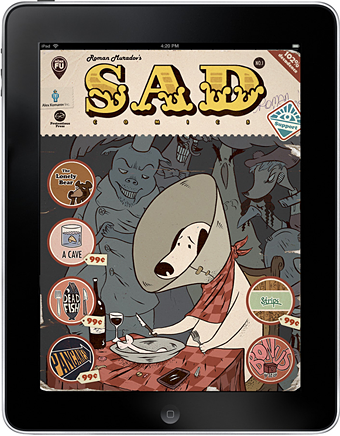
The four panels I was on went off without a hitch. After the fourth on Saturday, I talked for a long time to two teams of iPad comics creators about the challenges of that new platform, and was reminded of how young the mobile space still is.

Speaking of young, Ivy and I got to meet Juni Kibuishi for the first time (above—and yes, Ivy’s hair is purple again!). I watched his eyes watching everything and was reminded how unpredictable each generation of creative minds can be.

Raina Telgemeier’s terrific all-ages Smile sold out at the show. We talked at the First Second dinner about the dozen other subjects that deserved the comics treatment and what a difference Raina’s personal touch and wise storytelling choices made.

Of the hundred thousand plus who descended on San Diego last week, maybe a few hundred were aspiring young artists or writers making the journey for the first time.

It’s easy for a dedicated young artist to believe that if their work is good enough, it’ll rise and rise until they’re the ones at the Hall H microphones (or at least Ballroom 20) and it’s their characters being painted on the side of the Bayfront Hilton.

It’s also easy, after a few years of frustration, for even the best young cartoonists to believe that the system is rigged, and no matter how hard they work, there’ll be enormous obstacles put in their way that have nothing to do with the quality of their stories and art.

Both are true, of course. Good work will rise to its level AND the system is rigged. Which is why, if you want to find a common denominator among the success stories at San Diego, it’s patience.

For example, bookstore buyers don’t always understand Telgemeier’s Smile. The children’s comics market in bookstores is still immature and the obstacles for new authors are numerous and frustrating. But as soon as kids actually got their hands on the book (often through book fairs), it became a big hit. The book itself made all the difference.

One of the iPad hopefuls I talked to was Robert Berry whose Ulysses adaptation was originally rejected by Apple for nudity. It’s a smart, well-designed work that was nearly killed in the cradle, but its future actually looks pretty bright now that Apple was embarrassed into reversing their decision. Joyce’s legacy may deserve part credit for the reversal, but the quality of the work will carry it from here on.

And Scott Pilgrim for YEARS couldn’t get shelved in one of the biggest book chains in America. The “system” was truly rigged against it. Yet here we are.

Will Eisner insisted again and again that CONTENT would always drive the industry and the art form. No matter what happened at the retail, publishing, or distribution levels; it was what happened on the page and in the panels that would make all the difference.

I believe it more every year.


Seven Languages Plus One

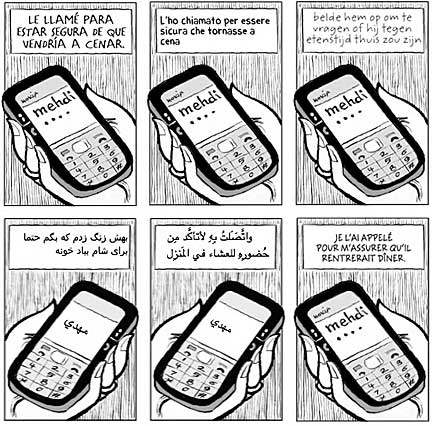
Zahra’s Paradise is a new comic being offered online by First Second. From what we’ve seen, it promises to be an absorbing true story and I like the art. It’s being released simultaneously in English, Farsi, Arabic, French, Spanish, Italian, Dutchs—seven languages in all. Eight, if you count the language of comics.

Zahra’s release follows closely on the heels of Valentine, released in a whopping twelve languages simultaneously. If this is a trend, I like it.

[Edit to add: In the original post, I'd referred to Valentine as "Robot Comics' Valentine"—it's actually available from Robot Comics, Comixology, Ave! Comics in France, and others soon. Needless to say, the multiple publishers aspect may be even more important in the long run if that trend also continues. Oh, and they're already up to 14 languages.]

Understanding Comics has been translated over the years into 16 languages, but like any book project, the process of getting it printed and distributed from scratch in each country requires an enormous amount of effort for its respective publishers.

The idea that all these dammed-up rivers of art and story might start breaking free all over the world soon is encouraging.


I’m Sure it Seemed Like a Good Idea at the Time

I wasn’t checking Twitter much yesterday, but Ivy (my wife, not the comic book character this time) pointed out @BGFCentral’s knowing tweet:

Only men talking in the video, only male hands using the product in the video. Yup. Explains the name.

Can’t comment on the product yet—haven’t tried it—though various specs sound a bit underwhelming if it’s going to be displaying full-sized comics spreads. I guess we’ll see.

[Video via Heidi]


Bludzee

New Trondheim strips in my iPhone every day for a month? For a buck? I’m there.

Despite the long load times (a problem with all iPhone apps due to the fact that we actually USE the things), I like the format of the comics. They look like they were actually designed for the device instead of repurposed from print.

Also: Trondheim!


Thoughts?

“And as you can see, it actually knows how to read the comic for you.”

Not the first nor the last to employ this strategy for getting around printed comics on mobile devices, but they certainly win the award for most chilling tagline.

Has anyone tried the various mobile readers out there and compared them yet? I’d be curious to hear others’ reactions.


I Will Beat this Horse Again and Again until it RISES FROM THE DEAD

What’s the default shape of our art forms?

Cinema is wider than it is tall. TV is wider than it is tall. Theater is wider than it is tall. Laptop and desktop monitors are wider than they are tall. In fact, with the advent of widescreen TVs, there’s little difference in the shapes. They’re all around 3×5 or 4×5 range. Wider than tall. All of them.

And print? Well, print is taller than it is wide right? The printed page is the exception to the rule, isn’t it?

Wrong.

The default shape of print is not taller than wide. It’s wider than tall just like all the rest, because the default shape of print is two pages side-by-side. And the reason is the same reason as the shape of TV and cinema and theater and surfing and all the rest: because we have two eyes next to each other, not one on top of the other.

I don’t even have a Kindle yet, so this isn’t meant as a specific critique of the device. And I’m sure its engineers had solid practical reasons to design the device the way they did. You can even turn it sideways when needed.  It just reminded me when I went to Amazon this morning and saw images of the latest, how design principles in the wild can always be adjusted on the fly, but as soon as they’re embedded in hardware, they tend to stick around. For decades in some cases.

So if I could humbly suggest a new cardinal rule of designing anything meant to be read (including webcomics): Step #1, look in a mirror.

[Edit to add: Within ten minutes of posting, everybody has agreed that I'm utterly wrong about this! Oh well. Check the comments thread to see some smart, funny rebuttals.]


Ruben and Lullaby


Okay, not comics maybe, but you might want to check out this nicely executed choose-your-own-emotion game/story thingey by Erik Loyer and Ezra Clayton Daniels that I just downloaded to my iPhone.


Why Definitions Matter

“…Goldman started with a definition of what comics are: stories told with words and pictures”

[SXSW "Comics on Handhelds" panel - link via James Burns]

Dan Goldman is, I’m sure, using the above in the spirit of opening minds to comics’ range and flexibility. But under the image of the Watchmen “motion comic” it offers a grim reminder of how our conception of comics now can point us down some dark roads in the near future.

I don’t doubt that a lot of hard work and earnest creativity went into the building of the WMC, but if the future of comics is cheap pseudomovies on cell phones, you can count me out.